Отримуйте інформацію лише з офіційних джерел
Єдиний Контакт-центр судової влади України 044 207-35-46
English below
Диджиталізація сфери судочинства з урахуванням можливих кіберзагроз і викликів інформаційній безпеці є непростим процесом і в мирний час, а сьогодні, в умовах повномасштабної війни, розв’язаної росією проти України, цифровізація системи національного правосуддя особливо потребує підтримки та сприяння міжнародних партнерів. Попри воєнний стан українська судова система працює, і щороку на розгляді судів усіх інстанцій та юрисдикцій перебуває близько 5 млн 300 тис. справ. За таких умов технологічні нововведення у правосудді сприяють оптимізації та відкритості судових процесів.
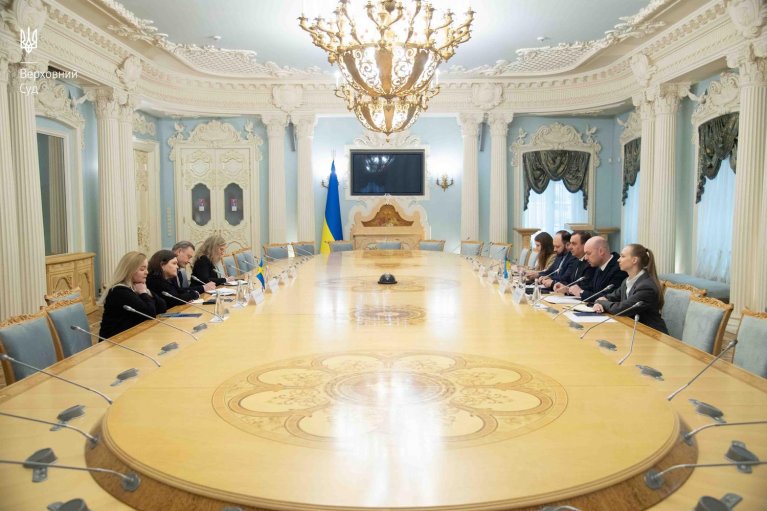
Про це зауважив Голова Верховного Суду Станіслав Кравченко під час зустрічі з представниками Шведської агенції з міжнародного розвитку та співробітництва (SIDA) і Лабораторії законодавчих ініціатив. Він подякував уряду Швеції та SIDA за послідовну підтримку України в часи війни та, зокрема, за ініціативу зі сприяння розвитку ЄСІКС для всіх українських судів, що відіграє важливу роль для подальшого функціонування України в європейському просторі.
.jpg)
Як повідомив Голова ВС, Верховний Суд не стоїть осторонь цифровізаційних процесів, у тому числі з огляду на потребу в забезпеченні єдності судової практики. Так, минулого року було оновлено функціонал і вдосконалено пошукові можливості Бази правових позицій ВС завдяки впровадженню можливостей генеративного штучного інтелекту. Також у лютому 2025 року Верховний Суд і Європейський суд з прав людини втілили спільний проєкт щодо покращення доступності знань про практику ЄСПЛ в Україні – запущено українськомовну версію Платформи обміну знаннями ЄСПЛ «Knowledge Sharing Platform» (ECHR-KS).
Керівник відділу підтримки України SIDA Малін Перхульт і радник, керівник департаменту розвитку і співробітництва у сфері реформ Посольства Швеції в Україні Крістіна Даніельсон висловили солідарність з Україною в цей визначальний час та наголосили, що нині підтримка України – пріоритетний напрям для уряду Швеції. За словами міжнародних партнерів, для шведської сторони важливо почути з перших уст потреби та очікування української судової системи на шляху подальшої цифровізації правосуддя.
.jpg)
Т. в. о. керівника Апарату Верховного Суду Расім Бабанли акцентував, що завдяки розширенню на законодавчому рівні у 2023 році потенціалу електронного документообігу в судах лише Верховному Суду вдалося заощадити близько 10 млн грн на поштовій кореспонденції. Запровадження ж ЄСІКС як уніфікованої системи для всіх судів забезпечить оперативний обмін документами між судами і дасть змогу зрозуміти й вирішити проблеми в конкретних судах. Диджиталізація судових процесів також вивільнить час суддів від рутинної роботи для розгляду саме складних справ. До того ж використання спроможностей ЄСІКС для забезпечення єдності судової практики й ефективного судового менеджменту передбачено і Дорожньою картою з питань верховенства права як одну з умов успішної євроінтеграції України.
На завершення зустрічі Голова ВС запевнив, що Верховний Суд і надалі докладатиме всіх зусиль для виконання зобов’язань за підписаним торік у жовтні Меморандумом, що передбачає реалізацію проєкту Лабораторії законодавчих ініціатив і SIDA з цифровізації судової системи в Україні.
У зустрічі взяли участь також координатор проєктів співробітництва департаменту розвитку і співробітництва у сфері реформ Посольства Швеції в Україні Василь Романюк, виконавча директорка Лабораторії законодавчих ініціатив Світлана Матвієнко, т. в. о. начальника відділу міжнародного співробітництва Анастасія Кулик і головний спеціаліст відділу міжнародного співробітництва Артем Ніколаєнко.
Priority areas for further cooperation in the digitalisation of justice discussed at the Supreme Court during a meeting with representatives of the Swedish International Development Cooperation Agency (SIDA)
Digitalization of the judiciary, taking into account potential cyber threats and information security challenges, is a complex process even in peacetime; today, in the context of the full-scale war unleashed by Russia against Ukraine, the digitalization of the national justice system is particularly in need of support and assistance from international partners. Despite martial law, the Ukrainian judicial system continues to function, with approximately 5.3 million cases pending before courts of all instances and jurisdictions each year. Under such conditions, technological innovations in the administration of justice contribute to the optimisation and greater openness of judicial proceedings.
This was noted by the President of the Supreme Court, Stanislav Kravchenko, during a meeting with representatives of the Swedish International Development Cooperation Agency (SIDA) and the Agency for Legislative Initiatives. He thanked the Government of Sweden and SIDA for their consistent support of Ukraine during the war and, in particular, for the initiative to promote the development of the Unified Judicial Information and Communication System (UJICS) for all Ukrainian courts, which plays an important role in Ukraine’s further integration into the European space.
As the President of the Supreme Court reported, the Supreme Court is actively involved in digitalisation processes, including with a view to ensuring the uniformity of case law. Thus, last year, the functionality and search capabilities of the Database of Legal Positions of the Supreme Court were updated and improved by introducing generative artificial intelligence features. In addition, in February 2025, the Supreme Court and the European Court of Human Rights implemented a joint project to improve access to knowledge about ECHR case law in Ukraine: the Ukrainian-language version of the ECHR Knowledge Sharing Platform (ECHR-KS) was launched.
Malin Perhult, Head of SIDA’s Ukraine Support Unit, and Christina Danielsson, Counsellor, Head of Section for Reform Cooperation at the Embassy of Sweden in Ukraine, expressed solidarity with Ukraine at this defining moment and stressed that supporting Ukraine is currently a priority direction for the Government of Sweden. According to the international partners, it is important for the Swedish side to hear directly from the Ukrainian judicial system about its needs and expectations on the path towards further digitalisation of justice.
The Acting Chief of the Supreme Court Staff, Rasim Babanly emphasised that, thanks to the legislative expansion in 2023 of the potential for electronic document management in courts, the Supreme Court alone has saved approximately UAH 10 million on postal correspondence. The introduction of the Unified Judicial Information and Communication System (UJICS) as a standardised system for all courts will ensure prompt exchange of documents between courts and will enable the identification and resolution of problems in specific courts. The digitalisation of judicial proceedings will also free up judges’ time from routine work, allowing them to focus on considering complex cases. Moreover, the use of UJICS capabilities to ensure the uniformity of case law and effective judicial management is provided for in the Rule of Law Roadmap as one of the conditions for Ukraine’s successful European integration.
At the conclusion of the meeting, the SC President assured that the Supreme Court will continue to make every effort to fulfil the commitments undertaken under the Memorandum signed last October, which envisages the implementation of a project by the Agency for Legislative Initiatives and SIDA on the digitalisation of the judicial system in Ukraine.
The meeting was also attended by Vasyl Romaniuk, Project Cooperation Coordinator of the Section for Reform Cooperation at the Embassy of Sweden in Ukraine; Svitlana Matviienko, Executive Director of the Agency for Legislative Initiatives; Anastasiia Kulyk, Acting Head of the Division for International Cooperation; and Artem Nikolaienko, Chief Specialist of the Division for International Cooperation.

_03_03.png)